Benedetto Marcello

Classical
Classical Crossover
 Viberate Rank: 263041
 Viberate Rank: 263041
 Monthly ListenersFollowers
 Subscribers
 Followers
 Followers
 FansTop Spotify SongsTop YouTube Videos
| Video | 7-Day Views | |
|---|---|---|
1 | 2 |
Monthly ListenersFeatured in Playlists| Playlist | Followers | |
|---|---|---|
1 | 1131466371 | 65.51K |
2 |  Klassik zum Entspannen Filtr Germany | 42.04K |
3 |  Harpsichord Music Clavecins Sans Frontières | 20.10K |
4 |  ░░░ 60 bpm Baroque & Study | Learning Music Siim | 19.46K |
5 | Classical Flute sabikam | 15.91K |
Audience| City | Monthly Listeners | |
|---|---|---|
1 |  | 498 |
2 |  | 452 |
3 |  | 376 |
4 |  | 359 |
5 |  | 350 |
See full performance history, audience data, playlist activity, rankings, comparisons, and more in Viberate music analytics. Start with a free trial, then continue with a paid plan.
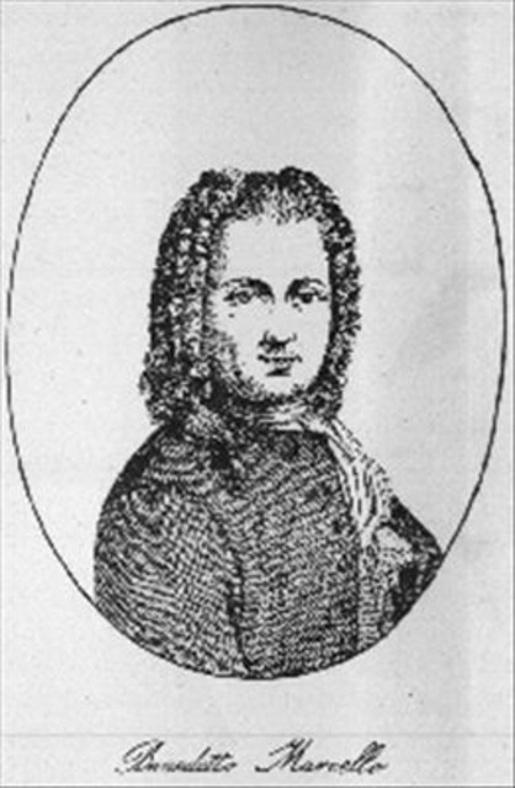
Benedetto Marcello’s Spotify BioBefore the early years of the twentieth century, any list of significant Western composers from past eras would have included the name of Benedetto Marcello. Through his advocacy of a return to the proportional values and simplicity of ancient Greco-Roman civilization, Marcello helped set the stage for the Classical era in Western music, soon to unseat the aesthetic norms of the Baroque in which Marcello lived and worked. Nonetheless, controversy and confusion surrounding his works and history have considerably dimmed Marcello's star. Many of the instrumental works once believed by Marcello are actually by others. Composer Alessandro Marcello was Benedetto's older brother, and some of Alessandro's music has been misattributed to Benedetto. Various instrumental pieces attributed to Marcello are merely instrumental arrangements of his Psalmi, in some cases made decades after his death.
Marcello was what eighteenth century chroniclers called a "dilettante"; not a dabbler as in the current… vernacular, but an aristocrat who also pursued musical composition as a sideline. Born in Venice, Marcello served the Venetian Republic as a magistrate from about 1708 until 1728, when he was exiled to the resort city of Pula, now in Croatia. In 1738 Marcello was appointed to his final position as chief financial officer of the city of Brescia, but died after less than a year in this job on or around his 53rd birthday.
Marcello was best known in his day through his massively influential eight-volume publication Estro poetico-armonico (1724-1726), popularly known as the "Psalmi." It is a collection of 50 psalm settings for male voices. Marcello's sacred vocal music was revered by most of his contemporaries as representing the supreme example of contrapuntal technique, and he was in use in teaching through the end of the nineteenth century. Scarcely less popular was his treatise, Il teatro alla moda (1720), a satire that skewered the opera world of his time. Marcello wrote nearly 400 cantatas, some so well known that they exist in up to 25 contemporary manuscript copies, in addition to oratorios, operas, and nearly 100 small chamber works for singers. His surviving instrumental catalog is less generous, mostly consisting of keyboard sonatas, but also containing a few sinfonias and concertos. All of Marcello's instrumental music was composed by 1710 or thereabouts; the set of 12 concerti published as Marcello's "Op. 1" in 1708, including the work transcribed by Johann Sebastian Bach as BWV 981, is lacking its first violin part.
Viberate is a music analytics platform built for A&Rs, artist managers, labels, booking agents, marketers, and artists.
It helps music professionals track artist growth, analyze audience data, monitor playlist activity, compare artists, follow song performance, and identify opportunities across the music market.
Public artist pages provide a free preview of selected artist data. Paid plans provide access to deeper analytics, historical data, charts, comparisons, playlist tools, exports, alerts, reports, and additional professional features.
Yes. Public Viberate artist pages provide selected artist analytics and music data for free.
Viberate also offers a 7-day free trial of the full platform. A credit card is required to start the trial. The trial includes access to the complete product so users can test deeper artist analytics, historical views, playlist insights, comparisons, charts, exports, alerts, and reporting features before choosing a paid plan.
Viberate provides artist analytics across streaming, playlists, social media, video, radio airplay, songs, and audience markets.
Users can analyze Spotify performance, Spotify and Apple Music playlists, YouTube activity, TikTok and Instagram growth, radio spins, song performance, audience locations, demographics, rankings, and overall artist momentum.
Artist profiles also connect to music charts, similar artists, and comparison tools, helping users benchmark performance and evaluate artists in context.
Viberate updates key artist and track data daily.
For followed artists and tracks, selected data is refreshed multiple times per day. This helps teams monitor playlist changes, streaming movement, audience growth, releases, and campaign performance with more current data.
Update frequency can vary depending on the metric and data source.
Yes. Viberate lets users compare up to five artists side by side across streaming, social media, audience, and engagement metrics.
Users can compare fanbase growth, audience demographics, locations, Spotify performance, social metrics, and other artist data over selected time periods.
Artist comparison can be used for A&R scouting, benchmarking, booking decisions, campaign planning, and evaluating artists with similar audiences or market positions.