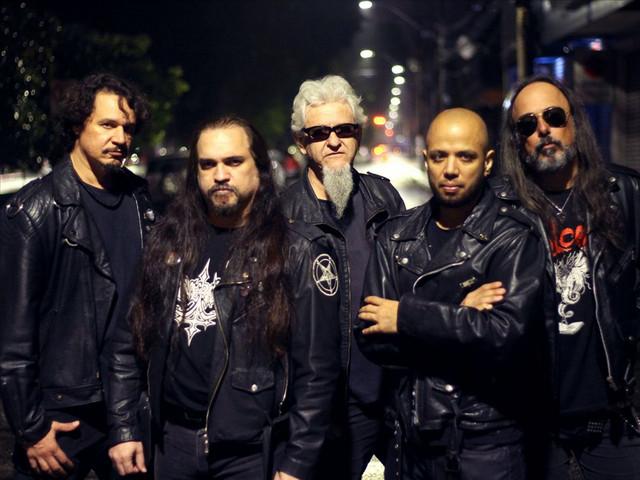
Vulcano

Metal
Black Metal
Death Metal
Thrash Metal
 Viberate Rank: 149476
 Viberate Rank: 149476
 Monthly ListenersFollowers
 Subscribers
 Followers
 Followers
 FansTop Spotify Songs
| Track | 7-Day Streams | |
|---|---|---|
1 | 995 | |
2 | 546 | |
3 | 478 | |
4 | 308 | |
5 | 286 |
Top YouTube VideosMonthly ListenersFeatured in Playlists| Playlist | Followers | |
|---|---|---|
1 |  FENRIZ METAL Gylve | 32.35K |
2 | Thrash Metal 12124165724 | 12.18K |
3 |  Metal BR Pesado Static Progress | 8.07K |
4 |  Early Thrash: The '80s & '90s Loudwire | 8.05K |
5 |  BLACKMETAL DSBM badyushka🕷️🩸 | 3.61K |
Audience| City | Monthly Listeners | |
|---|---|---|
1 | | 369 |
2 |  | 114 |
3 | | 83 |
4 |  | 73 |
5 | | 66 |
See full performance history, audience data, playlist activity, rankings, comparisons, and more in Viberate music analytics. Start with a free trial, then continue with a paid plan.
Vulcano’s Spotify BioVulcano were one of Brazil's first heavy metal bands of note. Coming into existence some time before (and having no small influence upon) that country's most famous metal export, Sepultura, Vulcano's albums were far too inaccessible to surface above the heavy metal underground with any regularity; and yet, alongside fellow Brazilians Sarcofago, Mutilator, and others, their primal, astoundingly violent blend of black and thrash metal has attained a worldwide cult legend among some of the genre's most extreme practitioners -- notably, Norway's feared black metal inner circle of the early '90s.
Vulcano evolved from an earlier band called Astaroth, circa 1981, and is essentially the vision of bassist, guitarist, and chief songwriter Zhema Rodero. Together with guitarist Paulo Magrão, keyboardist Carli Cooper, and numerous long-forgotten henchmen, Zhema struggled to ignite the band's career early on, eventually trading his native town of Osasco for the larger port city of Santos. Once there,… the musicians hooked up with singer Genne and drummer José Piloni to record the four-track Om Pushne Namah single in 1983, but splintered shortly thereafter, opening the door for the arrival of new members Johnny Hansen (guitar), Renato Pelado (drums), and Angel (vocals), who made it possible for Vulcano to switch from Portuguese to English lyrics. This lineup quickly came up with 1984's much improved, eight-track Devil on My Roof demo, and when Vulcano scrapped together enough dough to record a concert, in August of the following year, the ensuing Vulcano: Live! LP (introducing guitarists Soto Júnior and Zé Flávio, and drummer Laudir Piloni) effectively put them on the metal map. By now, Brazilian heavy metal was starting to single out its first champions, and Vulcano seized the mantle of extremism with their thrashy black metal (chiefly inspired by Britain's Venom and Motörhead), which left chief competitors like Dorsal Atlantica and Korzus sounding tame by comparison.
If there was anything one could remotely consider "success" in the unforgiving world of Brazilian heavy metal, Vulcano experienced it in 1986: a year which saw them record the seminal Bloody Vengeance album for Rock Brigade Records, and be selected to support visiting metal dignitaries Venom and Exciter on a tour across Brazil. Ironically, Vulcano's first taste of national press exposure also introduced their "dangerously immoral" music, unconventional stage-wear, and anti-religious philosophies to all of Brazil's self-righteous authority figures -- most worrisomely the police. The backlash convinced Angel and Zhema (now back to playing guitar) that perhaps the time had come to mix a few new topics (social issues, emotional and political repression, errr...cannibalism) into the usual Satanic stew, and they also took the opportunity to hire new bassist Fernando Levine and drummer Arthur Vasconcelos to perform on 1987's more considered but inevitably less spontaneously combusting Anthropophagy album. This same lineup recorded the following year's thrash and speed metal-focused Who Are the True?, which doubled as commentary for what Zhema thought was an increasingly calculated and poser-filled Brazilian heavy metal scene. Second guitarist Soto Júnior rejoined Vulcano in time for 1990's lackluster Rat Race, but by then Zhema had become fed up with it all -- particularly with not getting paid by an endless parade of shifty record companies -- and decided to officially break up the band.
Vulcano briefly reconvened with Zhema, Soto, Arthur, and temporary vocalist Luiz Carlos to cut three tracks for Cogumelo Records' reissue of Live!, in 1988, but the musicians spent the rest of the decade preoccupied with different projects, like Zhema's Creedence Clearwater Revival tribute band with original Vulcano guitarist Magrão. Sadly, Soto Júnior passed away from a sudden heart attack in 2001, at the age of 39, but just three years later Angel, Zhema, and Arthur reunited Vulcano with the help of new guitarists André and Passamani, and recorded 2004's startlingly powerful Tales from the Black Book. ~ Eduardo Rivadavia, Rovi
Viberate is a music analytics platform built for A&Rs, artist managers, labels, booking agents, marketers, and artists.
It helps music professionals track artist growth, analyze audience data, monitor playlist activity, compare artists, follow song performance, and identify opportunities across the music market.
Public artist pages provide a free preview of selected artist data. Paid plans provide access to deeper analytics, historical data, charts, comparisons, playlist tools, exports, alerts, reports, and additional professional features.
Yes. Public Viberate artist pages provide selected artist analytics and music data for free.
Viberate also offers a 7-day free trial of the full platform. A credit card is required to start the trial. The trial includes access to the complete product so users can test deeper artist analytics, historical views, playlist insights, comparisons, charts, exports, alerts, and reporting features before choosing a paid plan.
Viberate provides artist analytics across streaming, playlists, social media, video, radio airplay, songs, and audience markets.
Users can analyze Spotify performance, Spotify and Apple Music playlists, YouTube activity, TikTok and Instagram growth, radio spins, song performance, audience locations, demographics, rankings, and overall artist momentum.
Artist profiles also connect to music charts, similar artists, and comparison tools, helping users benchmark performance and evaluate artists in context.
Viberate updates key artist and track data daily.
For followed artists and tracks, selected data is refreshed multiple times per day. This helps teams monitor playlist changes, streaming movement, audience growth, releases, and campaign performance with more current data.
Update frequency can vary depending on the metric and data source.
Yes. Viberate lets users compare up to five artists side by side across streaming, social media, audience, and engagement metrics.
Users can compare fanbase growth, audience demographics, locations, Spotify performance, social metrics, and other artist data over selected time periods.
Artist comparison can be used for A&R scouting, benchmarking, booking decisions, campaign planning, and evaluating artists with similar audiences or market positions.