 Viberate
Samuel Barber
 USAClassical, Chamber Music, Orchestral
N/A monthly listeners
 USAClassical, Chamber Music, Orchestral

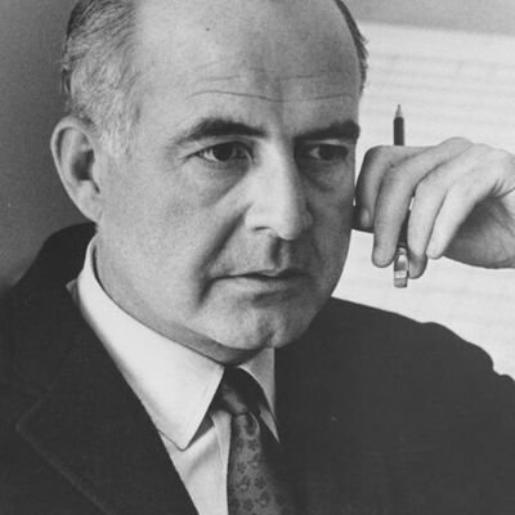
American classical music composer Samuel Barber is renowned for his contributions to chamber music. Barber, who was raised in West Chester, Pennsylvania, was a prolific musician who produced a wide variety of songs during his lifetime. His compositions are notable for their lush orchestration and emotional depth, frequently fusing conventional and contemporary approaches.
Barber wrote a lot of chamber music, and his pieces were known for their complex harmonies and evocative melodies. His compositions for string quartet, including the well-known "Adagio for Strings," are regarded as some of the most affecting and potent in the genre. Barber has become a renowned figure in the world of classical music thanks to his exceptional capacity to convey emotion through his music, and his legacy continues to motivate new generations of performers.
Samuel Barber is still regarded as one of the most important and revered classical music composers of the 20th century despite passing away prematurely in 1981. His contributions to the chamber music genre are evidence of his brilliance and commitment, and audiences all around the world continue to play and appreciate his compositions.
American classical and chamber music performer Samuel Barber is renowned for his exquisite works that have lasted the test of time. Three of his most well-known compositions are "Adagio for Strings," "Molto Adagio," and "Adagio for Strings (Arr. for Orchestra from String Quartet, Op. 11)."
Barber's "Adagio for Strings" is without a doubt his most well-known composition, and it has been featured in innumerable movies, TV shows, and other forms of media. It has become a classic and a favorite among musicians and listeners alike due to its eerie melody and intense emotional content. The well-known song "Molto Adagio" is another example of Barber's expert use of strings to produce a beautiful and melancholy sound.
Samuel Barber also composed the well-known songs "Barber: Adagio for Strings," "Adagio for Strings, Op. 11a," and "Adagio for Strings, Op. 11 No. 2 (From Platoon & Elephant Man)." The melody and emotional depth of these songs are also well-known, and they are frequently used in numerous mediums to elicit feelings of sadness or desire.
Overall, Samuel Barber's works are examples of his musical brilliance and prowess. His knack for writing heartfelt, moving music that connects with listeners is what has made his music so enduring and well-liked. Whether you like classical music or not, you should give his tracks a try.
The well-known American composer Samuel Barber has recently put out a number of new songs and albums. A selection of some of his most exquisite and emotional songs can be found on his most recent CD, "Adagios," which was released in 2023.
Barber published a number of new songs in addition to his most recent album, including "Hermit Songs, Op. 29: X. The Desire for Hermitage" and "Three Songs, Op. 2: I. The Daisies" in 2022. These singles demonstrate Barber's adept compositional abilities and his capacity to produce works that emotionally connect with listeners.
"Barber: Fresh from West Chester: II" is another famous Barber single that was released in 2022. Let's watch it together; I'd rather." This song is proof of Barber's versatility as a composer because it has a catchy, uplifting tune that will make listeners want to dance.
"Violin Concerto, Op. 14: II. Andante," another great track from Barber's 2021 album, exemplifies his extraordinary gift for crafting dense and subtle compositions that are compelling and deeply touching. Overall, Barber's most recent works show that he is still a vital classical and chamber music composer.
In his career, American composer Samuel Barber worked with a variety of creatives. Two of his most significant compositional partnerships are "Molto Adagio" with Leonard Bernstein and the New York Philharmonic and "Adagio for Strings" with Stjepan Hauser and the London Symphony Orchestra.
The "Adagio for Strings" is a well-known piece of classical music, and Hauser's evocative cello playing along with the expansive sound of the London Symphony Orchestra takes the track to new heights. Bernstein's performance of "Molto Adagio" is also significant because the intensity of emotion in Barber's composition is brought out by both his impassioned conducting and the New York Philharmonic's deft playing.
For "Barber: Adagio for Strings, Op. 11a," the Philadelphia Orchestra and other notable musicians collaborated. Barber's brilliant composition and the orchestra's full tone combine to produce a hauntingly beautiful work that is both ageless and emotive.
Barber's association with many composers for "Carmina Burana" is equally important, albeit being less widely known. The score, which was created by Dmitri Shostakovich, Joaquin Rodrigo, Ralph Vaughan Williams, and Claude Debussy, offers a distinctive and complex version of the well-known work.
Last but not least, Voces8's rendition of "Agnus Dei" is a breathtaking illustration of the beauty that may be produced via cooperation. The eight voices flawlessly mesh to provide a hauntingly gorgeous performance of Barber's tune.
Overall, Barber's artistic alliances with other creatives have enhanced his output and highlighted the richness and intensity of his works.
Viberate is a professional music analytics service that provides a complete data overview of Samuel Barber, covering audience data, Spotify playlists and stats, individual track performance, and cross-platform metrics including Spotify, YouTube, streaming, and radio airplay analytics. The platform also includes full social media analytics across Instagram, TikTok, and Facebook, as well as insights from Apple Music playlists, SoundCloud, Beatport, Shazam, and Deezer, alongside artist charts, streaming charts, genre charts, and genre analytics to support A&R discovery, benchmarking, and strategic decision-making.
