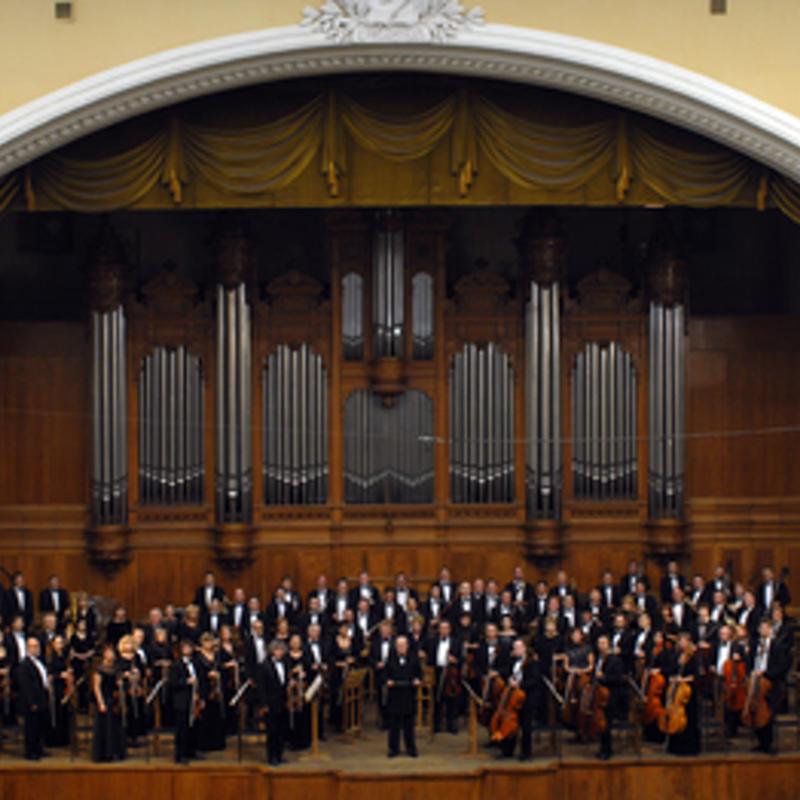
Russian State Symphony Orchestra

Classical
Orchestral
Chamber Music
 Viberate Rank: 65846
 Viberate Rank: 65846
 Monthly ListenersFollowers
 Subscribers
 Followers
 Followers
 FansTop Spotify Songs
| Track | 7-Day Streams | |
|---|---|---|
1 | 408.03K | |
2 | 62.06K | |
3 | 24.60K | |
4 | 16.31K | |
5 | 3.65K |
Top YouTube VideosMonthly ListenersFeatured in Playlists| Playlist | Followers | |
|---|---|---|
1 |  Classical Essentials Spotify | 3.82M |
2 |  royalcore Spotify | 550.54K |
3 |  Música Clásica Germán García Lillo | 341.87K |
4 |  Música Clásica Que Sí Es Clásica José Gonzales | 339.69K |
5 |  Classical Music bangers 🔥🔥 Carlijn | 241.23K |
Audience| City | Monthly Listeners | |
|---|---|---|
1 |  | 32.35K |
2 |  | 17.63K |
3 |  | 16.80K |
4 |  | 14.61K |
5 |  | 13.05K |
See full performance history, audience data, playlist activity, rankings, comparisons, and more in Viberate music analytics. Start with a free trial, then continue with a paid plan.
Russian State Symphony Orchestra’s Spotify BioThe Russian State Symphony Orchestra is one of Russia's leading orchestras. The group dates back to the first decades of the Soviet Union's existence. The orchestra has been among the most visible Russian orchestras in the West, frequently touring during outward-facing phases in Soviet and Russian history. The group has a large recording catalog on both Russian and Western labels, including the 2024 release of a 1995 recording featuring pianist Nikolai Lugansky in a pair of Rachmaninov piano concertos.
The Russian State Symphony Orchestra is also known as the State Academic Symphony Orchestra "Evgeny Svetlanov"; the term "Academic" in the name is honorific. It was founded as the USSR State Symphony Orchestra in 1936, with Alexander Gauk as its first conductor; its direct ancestors were a pair of Soviet radio orchestras founded in the early 1930s. The group fulfilled its responsibilities as a national group with a tour of the Soviet Union the following year. Gauk remained in his post… until 1941 and was succeeded by Nathan Rakhlin (1941-1945) and Konstantin Ivanov (1946-1965). The group often performs at the Great Hall of the Moscow Conservatory as well as other venues among Moscow's collection of magnificent concert halls. The orchestra made its first tour abroad during the "thaw" of the late '50s and early '60s, making its U.S. debut in 1960.
A turning point in the existence of the Russian State Symphony Orchestra came with the appointment as chief conductor of Evgeny Svetlanov in 1965. Svetlanov made an impact with a fiery recording of Stravinsky's Le Sacre du printemps and Petrouchka in 1966, marking quite a contrast from the group's earlier orientation toward conservative socialist-realist fare. That album remains in print, having been reissued in the West by Warner Classics in 2007. Svetlanov became an internationally celebrated conductor, amassing a large recording catalog (including, in the '90s, a massive 100-CD survey of Russian symphonic music) and often touring, especially after the fall of the Soviet Union. He was, in fact, fired in 2000 after charges that he was devoting too much energy to work abroad. Svetlanov was succeeded by Vassily Sinaisky (2000-2003) and Mark Gorenstein (2002-2011). Conductors Vladimir Jurowski (2011-2021) and Vasily Petrenko (2021-2022) managed to combine their duties with posts abroad; Petrenko departed after protesting the Russian invasion of Ukraine. The orchestra's artistic director as of late August 2024 was Philipp Chizhevsky (Chizhevskiy). The orchestra has continued to record prolifically, not only for the government-owned Melodiya label in Russia but also for such Western labels as Delos, Toccata Classics, and PentaTone. In the 2020s, the group has not been heard abroad on new recordings, but in 2024, a 1995 recording of Rachmaninov's Piano Concerto No. 3, Op. 30, and Piano Concerto No. 4, Op. 40, with pianist Nikolai Lugansky, was reissued by the Fineline label. ~ James Manheim, Rovi
Viberate is a music analytics platform built for A&Rs, artist managers, labels, booking agents, marketers, and artists.
It helps music professionals track artist growth, analyze audience data, monitor playlist activity, compare artists, follow song performance, and identify opportunities across the music market.
Public artist pages provide a free preview of selected artist data. Paid plans provide access to deeper analytics, historical data, charts, comparisons, playlist tools, exports, alerts, reports, and additional professional features.
Yes. Public Viberate artist pages provide selected artist analytics and music data for free.
Viberate also offers a 7-day free trial of the full platform. A credit card is required to start the trial. The trial includes access to the complete product so users can test deeper artist analytics, historical views, playlist insights, comparisons, charts, exports, alerts, and reporting features before choosing a paid plan.
Viberate provides artist analytics across streaming, playlists, social media, video, radio airplay, songs, and audience markets.
Users can analyze Spotify performance, Spotify and Apple Music playlists, YouTube activity, TikTok and Instagram growth, radio spins, song performance, audience locations, demographics, rankings, and overall artist momentum.
Artist profiles also connect to music charts, similar artists, and comparison tools, helping users benchmark performance and evaluate artists in context.
Viberate updates key artist and track data daily.
For followed artists and tracks, selected data is refreshed multiple times per day. This helps teams monitor playlist changes, streaming movement, audience growth, releases, and campaign performance with more current data.
Update frequency can vary depending on the metric and data source.
Yes. Viberate lets users compare up to five artists side by side across streaming, social media, audience, and engagement metrics.
Users can compare fanbase growth, audience demographics, locations, Spotify performance, social metrics, and other artist data over selected time periods.
Artist comparison can be used for A&R scouting, benchmarking, booking decisions, campaign planning, and evaluating artists with similar audiences or market positions.