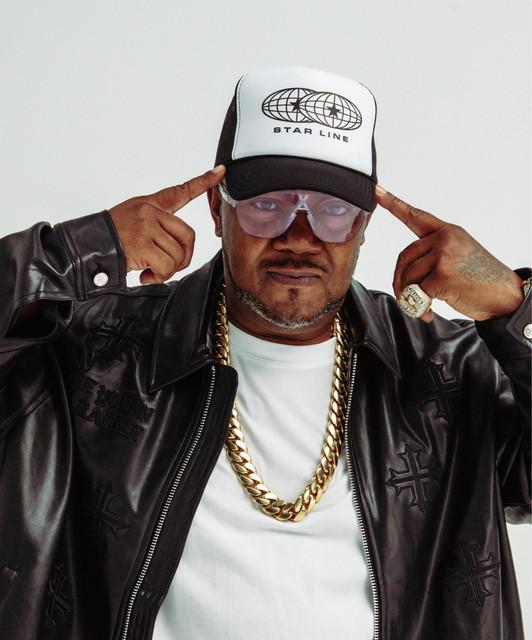
Lupe Fiasco

Hip Hop
Contemporary Hip Hop
Trap
 Viberate Rank: 2445
 Viberate Rank: 2445
 Monthly ListenersFollowers
 Subscribers
 Followers
 Followers
 FansTop Spotify Songs
| Track | 7-Day Streams | |
|---|---|---|
1 | 2.81M | |
2 | 1.81M | |
3 | 1.46M | |
4 | 596.27K | |
5 | 484.02K |
Top YouTube VideosMonthly ListenersFeatured in Playlists| Playlist | Followers | |
|---|---|---|
1 |  All Out 2000s Spotify | 12.95M |
2 |  Gold School Spotify | 4.00M |
3 |  Jazz Rap Spotify | 1.60M |
4 |  This Is Kanye West Spotify | 1.50M |
5 |  Feel Good Friday Spotify | 1.06M |
Audience| City | Monthly Listeners | |
|---|---|---|
1 |  | 219.35K |
2 | | 182.47K |
3 | | 180.35K |
4 | | 175.36K |
5 | | 156.86K |
See full performance history, audience data, playlist activity, rankings, comparisons, and more in Viberate music analytics. Start with a free trial, then continue with a paid plan.
Lupe Fiasco’s Spotify BioOne of the most cerebral and enigmatic artists of his generation, Lupe Fiasco is also among the more prominent artists in hip-hop, as proven by Grammy recognition and several gold and platinum certifications. It took the Chicago native a few years to gain traction, but his name has been well-known since his featured appearance on Kanye West's "Touch the Sky" (2005), a hit single that set him up for success with the Top Ten albums Lupe Fiasco's Food & Liquor (2007), Lasers (2011), and Food & Liquor II: The Great American Rap Album, Pt. 1 (2012), the second of which topped the Billboard 200. Although Lupe specializes in complex narratives and creative metaphorical verses, he hasn't shied away from making singles with pop appeal, including the Top Ten hits "Superstar" and "The Show Goes On." After a decade of oft-strained relations with major-label Atlantic, Lupe gained a newfound level of creative independence during the latter half of the 2010s, heard on the connected full-lengths… Drogas Light (2017) and Drogas Wave (2018). The simultaneously conceptual and personal Drill Music in Zion (2022) and Samurai (2024) have seen Fiasco reaffirm his creative partnership with Soundtrakk, the producer of his early hits.
The Chicago-based MC, born Wasalu Muhammad Jaco, began rapping in junior high school and joined a group called da Pak several years later. The group signed to Epic, released one single, and split up, all before Lupe reached the age of 20. Thanks in part to the vocal support of Jay-Z, L.A. Reid signed Lupe as a solo artist to Arista, but before anything of significance was able to happen -- only a promo single and a couple guest appearances were set up -- Reid was fired. Lupe eventually landed at Atlantic, another major label. Preceded by several mixtapes, an appearance on Kanye West's "Touch the Sky," and his debut single "Kick, Push," the album Food & Liquor was set to surface in early 2006, though an unfinished version leaked in the spring, which pushed its official release back to September. The album peaked at number eight on the Billboard 200 and earned the rapper three Grammy nominations. "Daydreamin'," featuring Jill Scott, won the award for Best Urban/Alternative Performance. A highly conceptualized follow-up, The Cool, was released in December 2007. Led by "Superstar," Lupe's first Top Ten and platinum single, it earned gold certification and led to four additional Grammy nominations.
Despite a track record of significant commercial success and acclaim, Lupe met a number of obstacles on the way to the release of his third album, Lasers. The process culminated in a petition signed by over 30,000 followers who demanded that Atlantic release the long-delayed album, which was followed by a fan protest outside the label's New York City offices. Finally issued by Atlantic in March 2011, Lasers topped three charts: the Billboard 200, Hot R&B/Hip Hop Albums, and Hot Rap Albums. It was propelled by "The Show Must Go On" (which went Top Ten on the Hot 100) and "Out of My Head" (number 40 Hot 100; number 11 Hot R&B/Hip-Hop). Work on the MC's fourth album, Food & Liquor II: The Great American Rap Album, Pt. 1, began while the third one was in pre-release limbo. Its development and September 2012 birth were relatively uncomplicated. Never one to evade controversy, Lupe received some backlash for "Around My Way (Freedom Ain't Free)," due to its usage of Pete Rock & C.L. Smooth's 1992 classic "They Reminisce Over You (T.R.O.Y.)," and for "Bitch Bad," criticized so firmly by Spin magazine that it prompted Lupe to call for a boycott of the publication. The album extended Lupe's Billboard Rap Albums-topping streak and produced another major hit single, "Battle Scars."
A few non-album singles, including the Ed Sheeran collaboration "Old School Love," were scattered across 2014 and 2015. Fifth full-length Tetsuo & Youth, inspired by Lupe's Chicago upbringing and loaded with punch lines, was a return to form and nearly topped the rap chart. For 2016, three albums were plotted for release. Though he was thwarted by what he referred to as "clearance and mixing issues," Lupe was able to issue the singles "Pick Up the Phone" and "Made in the USA" during the year. That December, Lupe also uploaded a track, "N.E.R.D.," which featured a line considered anti-Semitic by the Anti-Defamation League. The rapper defended himself and announced "I'm officially not releasing anymore music" on social media. Drogas Light, featuring appearances from Ty Dolla $ign, Big K.R.I.T., and Rick Ross, nonetheless landed the following February as his first independently issued album via Thirty Tigers. Drogas Wave, inspired in part by a story about Africans who jumped from a slave ship, adapted to living underwater, and sunk other ships for the sake of freedom, arrived in September 2018. In June 2019, Fiasco issued the previously unreleased single "Run Game." Recorded in 2006, the track was the first entry in a compilation project, Chill's Spotlight, curated by the rapper's 1st & 15th label co-founder Charles "Chill" Patton. HOUSE, a collaborative EP with producer Kaelin Ellis arrived in July 2020 and was followed that October by TAPE TAPE, yet another EP featuring longtime Fiasco-associate Soundtrakk. 2022's album Drill Music in Zion was also assisted by Soundtrakk as Fiasco dipped into a file of recent beats he created and wrote rhymes in whirlwind fashion, finishing in a mere three days. The album features guest spots from vocalists Ayesha Jaco and Nayirah. Along with his musical pursuits, Fiasco joined the staff of MIT as a visiting professor in 2022, teaching a course on rap. Several standalone tracks arrived in 2023, including "SentRock," "Checkin," and the classic videogame-inspired "CHANNEL No3." The following June, Fiasco released Samurai, a set of eight new songs produced by Soundtrakk. ~ Andy Kellman, Rovi
Viberate is a music analytics platform built for A&Rs, artist managers, labels, booking agents, marketers, and artists.
It helps music professionals track artist growth, analyze audience data, monitor playlist activity, compare artists, follow song performance, and identify opportunities across the music market.
Public artist pages provide a free preview of selected artist data. Paid plans provide access to deeper analytics, historical data, charts, comparisons, playlist tools, exports, alerts, reports, and additional professional features.
Yes. Public Viberate artist pages provide selected artist analytics and music data for free.
Viberate also offers a 7-day free trial of the full platform. A credit card is required to start the trial. The trial includes access to the complete product so users can test deeper artist analytics, historical views, playlist insights, comparisons, charts, exports, alerts, and reporting features before choosing a paid plan.
Viberate provides artist analytics across streaming, playlists, social media, video, radio airplay, songs, and audience markets.
Users can analyze Spotify performance, Spotify and Apple Music playlists, YouTube activity, TikTok and Instagram growth, radio spins, song performance, audience locations, demographics, rankings, and overall artist momentum.
Artist profiles also connect to music charts, similar artists, and comparison tools, helping users benchmark performance and evaluate artists in context.
Viberate updates key artist and track data daily.
For followed artists and tracks, selected data is refreshed multiple times per day. This helps teams monitor playlist changes, streaming movement, audience growth, releases, and campaign performance with more current data.
Update frequency can vary depending on the metric and data source.
Yes. Viberate lets users compare up to five artists side by side across streaming, social media, audience, and engagement metrics.
Users can compare fanbase growth, audience demographics, locations, Spotify performance, social metrics, and other artist data over selected time periods.
Artist comparison can be used for A&R scouting, benchmarking, booking decisions, campaign planning, and evaluating artists with similar audiences or market positions.