Franz Krommer

Classical
Classical Crossover
 Viberate Rank: 549939
 Viberate Rank: 549939
 Monthly ListenersFollowers
 Subscribers
 Followers
 Followers
 FansTop Spotify SongsTop YouTube VideosMonthly ListenersFeatured in Playlists
| Playlist | Followers | |
|---|---|---|
1 |  The Bear Official Playlist Spotify | 65.39K |
2 | Happy Classical Rebecca Noelle | 7.89K |
3 | Jason Barber | 7.80K |
4 |  chaotic classical music trinity | 5.88K |
5 |  Chamber Music for Self-Renewal synergy555 | 4.21K |
Audience| City | Monthly Listeners | |
|---|---|---|
1 |  | 147 |
2 |  | 109 |
3 |  | 101 |
4 |  | 94 |
5 |  | 86 |
See full performance history, audience data, playlist activity, rankings, comparisons, and more in Viberate music analytics. Start with a free trial, then continue with a paid plan.
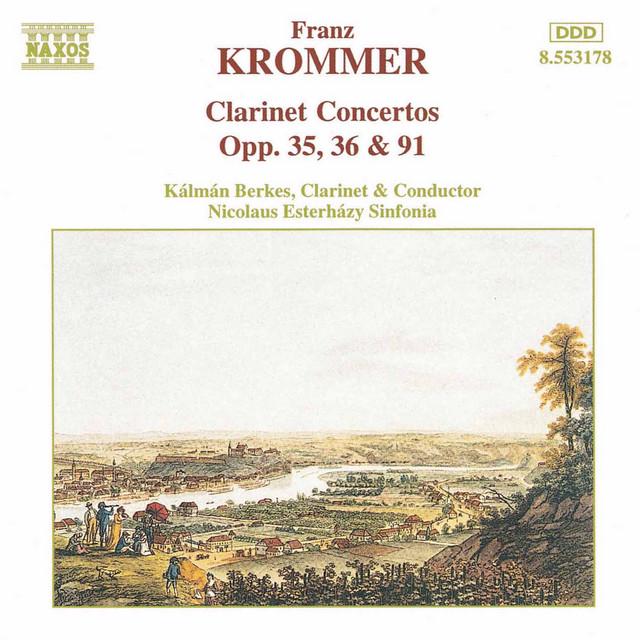
Franz Krommer’s Spotify BioFranz Krommer was considered a strong rival of Beethoven in the early nineteenth century, his string quartets especially being held in high esteem: more than a few contemporaries compared them with those of Haydn. In the decades following Krommer's death in 1831, however, his reputation faded, in large part because of the increasing dominance of Beethoven. Another factor that has hampered Krommer's popularity over the years is the variable appearance of his name. Instead of the German Franz Krommer, it is often stated as Frantisek Kramár, a Czech form of the name. Sometimes, however, both the German and Czech forms are combined, yielding the quaint Krommer-Kramár.
Born in the Moravian town of Kamenice (Kamenitz), Krommer divulged unusual talent early on and began studies in 1774 on the violin and organ with his uncle, Anton Matthias Krommer, composer and choirmaster at Turan. Through his uncle, Krommer became the temporary organist at Turan in 1777 or 1778. From his years of study with… his uncle until about 1785, Krommer also took it upon himself to learn theory and composition. He traveled to Vienna in 1785, but could find no steady work during the year or so he spent there. He obtained an appointment as a violinist in the Court orchestra of the Duke of Styrum in Simontornya (now part of Hungary), in about 1786. Although Krommer's earliest surviving works appear to date to the early 1790s, some may actually come from this period since he typically sought publication years after composition. In 1788, Krommer was appointed music director of the Duke's orchestra, but he departed the post in 1790 to become concertmaster at the Pecs Cathedral. He would also take on assignments at two smaller courts nearby as concertmaster, beginning in 1793. He returned to Vienna in 1795, where as a composer with a growing reputation, he is thought to have taught composition for the next three years. In 1798, he was appointed concertmaster at the court of Duke Ignaz Fuchs, where he remained until 1810. This dozen-year period would prove a fertile one for Krommer, with the publication of his earliest symphonies, concertos, and nearly 50 of his more than 70 string quartets. In 1811, Krommer accepted the appointment of ballet concertmaster at the Vienna Hoftheater. Four years later, he accepted the post of Kammertürhüter (Chamber door guardian) to Emperor Franz I, which required much travel. Krommer accompanied the Hapsburg ruler to various European cities in France and Italy over the next two years. In 1818, Krommer was elevated to the rank of court composer and director of chamber music under Franz I, succeeding Leopold Kozeluch. He served in this post until his death in 1831. During this final period, his creative output declined: though the last several of his approximately ten symphonies appeared, he wrote but a handful of string quartets and other compositions. Stylistically, Krommer's music reflected the spirit of Haydn and Mozart rather than that of Beethoven. He wrote an array of compositions in most genres, but produced no operas or lieder.
Viberate is a music analytics platform built for A&Rs, artist managers, labels, booking agents, marketers, and artists.
It helps music professionals track artist growth, analyze audience data, monitor playlist activity, compare artists, follow song performance, and identify opportunities across the music market.
Public artist pages provide a free preview of selected artist data. Paid plans provide access to deeper analytics, historical data, charts, comparisons, playlist tools, exports, alerts, reports, and additional professional features.
Yes. Public Viberate artist pages provide selected artist analytics and music data for free.
Viberate also offers a 7-day free trial of the full platform. A credit card is required to start the trial. The trial includes access to the complete product so users can test deeper artist analytics, historical views, playlist insights, comparisons, charts, exports, alerts, and reporting features before choosing a paid plan.
Viberate provides artist analytics across streaming, playlists, social media, video, radio airplay, songs, and audience markets.
Users can analyze Spotify performance, Spotify and Apple Music playlists, YouTube activity, TikTok and Instagram growth, radio spins, song performance, audience locations, demographics, rankings, and overall artist momentum.
Artist profiles also connect to music charts, similar artists, and comparison tools, helping users benchmark performance and evaluate artists in context.
Viberate updates key artist and track data daily.
For followed artists and tracks, selected data is refreshed multiple times per day. This helps teams monitor playlist changes, streaming movement, audience growth, releases, and campaign performance with more current data.
Update frequency can vary depending on the metric and data source.
Yes. Viberate lets users compare up to five artists side by side across streaming, social media, audience, and engagement metrics.
Users can compare fanbase growth, audience demographics, locations, Spotify performance, social metrics, and other artist data over selected time periods.
Artist comparison can be used for A&R scouting, benchmarking, booking decisions, campaign planning, and evaluating artists with similar audiences or market positions.