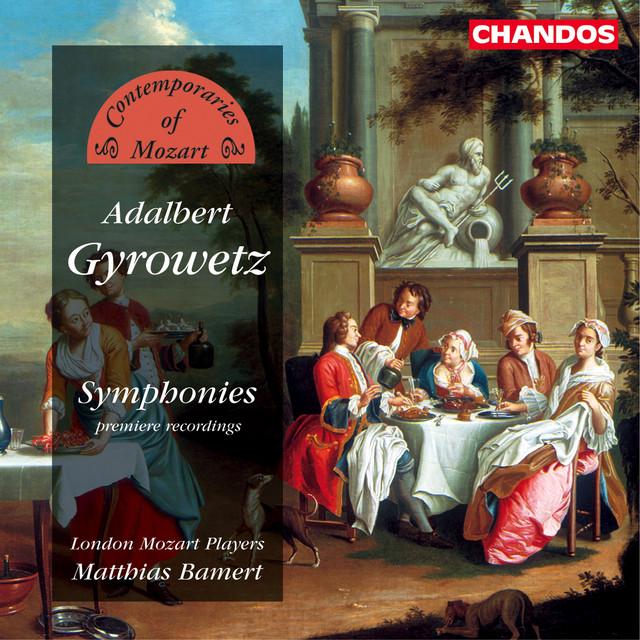
Adalbert Gyrowetz

Classical
Chamber Music
 Viberate Rank: 690211
 Viberate Rank: 690211
 Monthly ListenersFollowers
 Subscribers
 Followers
 Followers
 FansTop Spotify SongsTop YouTube VideosMonthly ListenersFeatured in Playlists
| Playlist | Followers | |
|---|---|---|
1 |  Kalm met Klassiek NPO Klassiek | 4.96K |
2 |  Chamber Music for Self-Renewal synergy555 | 4.21K |
3 |  Hooked on Classics Upbeat Instrumental for Work & Studying 1228799150 | 3.64K |
Audience| City | Monthly Listeners | |
|---|---|---|
1 |  | 80 |
2 |  | 39 |
3 |  | 35 |
4 |  | 28 |
5 |  | 25 |
See full performance history, audience data, playlist activity, rankings, comparisons, and more in Viberate music analytics. Start with a free trial, then continue with a paid plan.
Adalbert Gyrowetz’s Spotify BioAdalbert Gyrowetz was a Bohemian composer and conductor known for his string quartets and symphonies. During his time as the kapellmeister at the Vienna court theater, he was famous for his operas and ballets. He was born in 1763, in České Budějovice, a city in the South-eastern Czech Republic. His first musical instruction came in the form of violin and singing lessons from his father, who was the chorusmaster at the local cathedral. Later, he studied the organ and figured bass with Haparnorsky, a church organist who likely worked with Gyrowetz's father. In the late 1770s he studied law and music in Prague, but was unable to finish his schooling due to financial limitations. To support himself, he found employment in Brno as a secretary for Count Franz von Fünfkirchen. With the Count's support and encouragement, Gyrowetz began composing the first of his symphonies. Around 1785, he visited Vienna, where he met and befriended Haydn, Dittersdorf, and Mozart. Two years later, he traveled… to Italy and stayed in Naples, where he studied with Giovanni Paisiello and Nichola Sala. In 1789 he moved to Paris and discovered that some of his early string quartets and symphonies had been published under Haydn's name, because the works had a close resemblance to Haydn's style. This also proved to Gyrowetz that there was a huge demand for his compositions, which encouraged him even further. At the beginning of the French Revolution, he escaped to London, where he found almost immediate success as a composer and developed connections in the wealthiest of circles. He also helped Haydn get established on his trip to London in 1791.The next year, he returned to Bohemia so he could recover from some health problems and he continued composing. By 1804 he had relocated to Vienna where he began an appointment as a Kapellmeister for the court theater. His responsibilities in this position were very demanding, as he was required to compose an opera and a ballet every year. In this capacity, he composed the opera Agnes Sorel in 1806, which was so popular and successful that it received over 120 performances in Vienna over the next ten years. Outside of Vienna, the opera swept through Europe with translations in Danish, German, Hungarian, and Polish. Some of his other successful works from this period include the singspiel Der Augenarzt, and operatic works Robert oder Die Prufung and Il Finto Stanislao. In 1818, one of his piano concertos was performed by a very young Frederic Chopin in his debut as a soloist. Gyrowetz eventually retired in 1831 and spent his final years in Vienna, where he died in 1850. ~ RJ Lambert, Rovi
Viberate is a music analytics platform built for A&Rs, artist managers, labels, booking agents, marketers, and artists.
It helps music professionals track artist growth, analyze audience data, monitor playlist activity, compare artists, follow song performance, and identify opportunities across the music market.
Public artist pages provide a free preview of selected artist data. Paid plans provide access to deeper analytics, historical data, charts, comparisons, playlist tools, exports, alerts, reports, and additional professional features.
Yes. Public Viberate artist pages provide selected artist analytics and music data for free.
Viberate also offers a 7-day free trial of the full platform. A credit card is required to start the trial. The trial includes access to the complete product so users can test deeper artist analytics, historical views, playlist insights, comparisons, charts, exports, alerts, and reporting features before choosing a paid plan.
Viberate provides artist analytics across streaming, playlists, social media, video, radio airplay, songs, and audience markets.
Users can analyze Spotify performance, Spotify and Apple Music playlists, YouTube activity, TikTok and Instagram growth, radio spins, song performance, audience locations, demographics, rankings, and overall artist momentum.
Artist profiles also connect to music charts, similar artists, and comparison tools, helping users benchmark performance and evaluate artists in context.
Viberate updates key artist and track data daily.
For followed artists and tracks, selected data is refreshed multiple times per day. This helps teams monitor playlist changes, streaming movement, audience growth, releases, and campaign performance with more current data.
Update frequency can vary depending on the metric and data source.
Yes. Viberate lets users compare up to five artists side by side across streaming, social media, audience, and engagement metrics.
Users can compare fanbase growth, audience demographics, locations, Spotify performance, social metrics, and other artist data over selected time periods.
Artist comparison can be used for A&R scouting, benchmarking, booking decisions, campaign planning, and evaluating artists with similar audiences or market positions.