5000 Volts

Electronic
Dance
Disco
 Viberate Rank: 124764
 Viberate Rank: 124764
 Monthly ListenersFollowers
 Subscribers
 Followers
 Followers
 FansTop Spotify Songs
| Track | 7-Day Streams | |
|---|---|---|
1 | 16.17K | |
2 | 873 | |
3 | 873 | |
4 | 183 | |
5 | 116 |
Top YouTube VideosMonthly ListenersFeatured in Playlists| Playlist | Followers | |
|---|---|---|
1 |  1970s Greatest Hits Glenn Bugeja | 50.74K |
2 |  Seventies Hits 1970-1979 Victor Legerstee | 22.46K |
3 | Oldies But Goldies🎶🙌 Andreas (DJ Riga-cee) Rigazzi | 22.08K |
4 | 70s・80s ディスコ BEST tmnet-special.no1 | 18.85K |
5 | Best of 70er Dj_doerry | 14.20K |
Audience| City | Monthly Listeners | |
|---|---|---|
1 |  | 2.00K |
2 |  | 542 |
3 | | 532 |
4 | | 484 |
5 | | 435 |
See full performance history, audience data, playlist activity, rankings, comparisons, and more in Viberate music analytics. Start with a free trial, then continue with a paid plan.
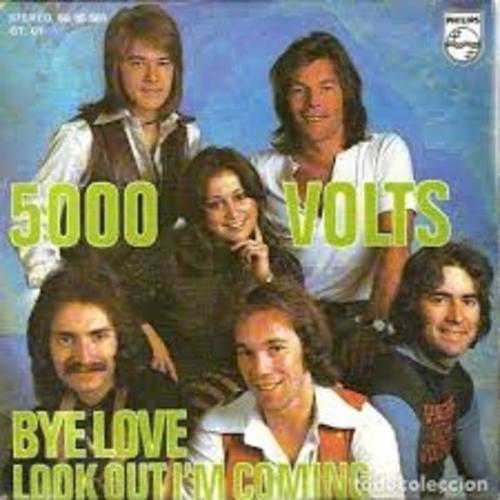
5000 Volts’ Spotify BioU.K. disco just wasn't the same after the electro-vamping two-hit wonders 5000 Volts shook up the scene in 1975. 5000 Volts was formed by two fairly well-known session vocalists, ex-Wild Honey singer Tina Charles and Martin Jay -- the pair had previously worked together in a band called Northern Lights and, reunited as a duo, they recorded their first single, "Bye Love," for producer Tony Eyers, adding the Eyers-penned "I'm on Fire" as the B-side. It was that song, of course, rather than the staid A-side, which would actually make a U.K. splash and ignite the band's fast burning flame. "Bye Love" was initially released under the band name Airbus on Phonogram in West Germany, just a few weeks before the U.K. imprint Philips snatched up the single for itself. Flipping the sides after encouragement from club DJs around the country, Philips also renamed the band with the more electric-sounding 5000 Volts. "I'm on Fire" was released in September and ultimately spent over two months on… the charts -- a run which culminated in a stellar number four hit for the group.
Riding that frothy wave, "I'm on Fire" began to sizzle worldwide, even hitting the U.S. Top 20 in late October, 1975. With Philips now crying out for a follow-up single and demand for an album also swelling, Jay and Charles added drummer Kevin Wells, bassist Martin Cohen (both ex-Northern Lights), and keyboardist Mike Nelson to the mix, giving 5000 Volts a truly supercharged, disco-pounding vibrant dimension.
Now a complete band, 5000 Volts hoped to work the magic again with their second single, "Look Out I'm Coming." Unfortunately, the group's hopes were dashed, at least in the United Kingdom, when the song failed to find any real commercial success. But, while the band seemed to founder on their own shores, they were proving to be an up-and-coming commodity across Europe, a fact that was only emphasized when their next European release, "Motion Man," breached the German Top 30. Such positive results not only gave the group a much-needed jolt, but also ensured that they would be booked to tour that country, at least, in 1976.
The pause in 5000 Volts' U.K. profile, meanwhile, allowed Charles some space in which to reignite the solo career she had been aiming for since the early '70s. During a gap in the schedule, she was contacted by Indian producer Biddu, himself impressed by her performance on "I'm on Fire"; the pair cut two singles during late 1975, with the second, "I Love to Love (But My Baby Just Loves to Dance" rocketing to the top of the British charts in February 1976. Caught in a quagmire of contention and argument that culminated in bitterness and accusation, Charles left the band to pursue her own fame, leaving 5000 Volts without a singer on the eve of the German tour that should have pushed them into the big time. The tour was scrapped, but the band vowed to continue, replacing Charles with vocalist Linda Kelly, and releasing a new single, "Dr Kiss-Kiss," in July. Oddly, the single reached number eight in the fickle U.K. market, but failed to stir the waters abroad. With the group's reputation irreparably damaged by the canceled tour, the foreign arm of their record labels lost all interest in the group. 5000 Volts, now out of favor, dropped from sight.
A handful of further U.K. singles and a self-titled album followed as the band tried to come back with "Light the Flame of Love," "Take me Back," and " (Walkin' On) A Love Cloud" throughout 1976. None of those songs registered with the commercial mainstream at all. One further single, "Can't Stop Myself from Loving You," appeared the following year before the band, never fully recovered from Charles' acrimonious departure, disbanded for good. Jay subsequently launched his own solo career, signing with DJM for a string of 45s through the late '70s. Further successes came as a member of the studio bands Enigma and Tight Fit in 1981, and the UK Mixmasters in 1990. ~ Amy Hanson, Rovi
Viberate is a music analytics platform built for A&Rs, artist managers, labels, booking agents, marketers, and artists.
It helps music professionals track artist growth, analyze audience data, monitor playlist activity, compare artists, follow song performance, and identify opportunities across the music market.
Public artist pages provide a free preview of selected artist data. Paid plans provide access to deeper analytics, historical data, charts, comparisons, playlist tools, exports, alerts, reports, and additional professional features.
Yes. Public Viberate artist pages provide selected artist analytics and music data for free.
Viberate also offers a 7-day free trial of the full platform. A credit card is required to start the trial. The trial includes access to the complete product so users can test deeper artist analytics, historical views, playlist insights, comparisons, charts, exports, alerts, and reporting features before choosing a paid plan.
Viberate provides artist analytics across streaming, playlists, social media, video, radio airplay, songs, and audience markets.
Users can analyze Spotify performance, Spotify and Apple Music playlists, YouTube activity, TikTok and Instagram growth, radio spins, song performance, audience locations, demographics, rankings, and overall artist momentum.
Artist profiles also connect to music charts, similar artists, and comparison tools, helping users benchmark performance and evaluate artists in context.
Viberate updates key artist and track data daily.
For followed artists and tracks, selected data is refreshed multiple times per day. This helps teams monitor playlist changes, streaming movement, audience growth, releases, and campaign performance with more current data.
Update frequency can vary depending on the metric and data source.
Yes. Viberate lets users compare up to five artists side by side across streaming, social media, audience, and engagement metrics.
Users can compare fanbase growth, audience demographics, locations, Spotify performance, social metrics, and other artist data over selected time periods.
Artist comparison can be used for A&R scouting, benchmarking, booking decisions, campaign planning, and evaluating artists with similar audiences or market positions.